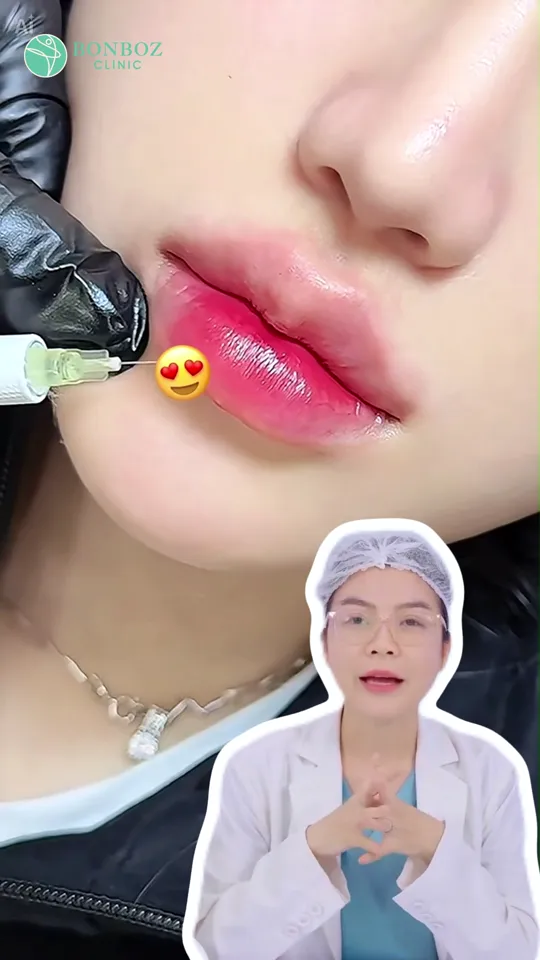
How long does filler take to soften, settle and stabilise? When to top up
How long does HA filler take to soften, settle into shape and stabilise? This article covers the key milestones in the first weeks, based on hyaluronic acid (HA) filler manufacturers' documentation. It also explains when to schedule a top-up and a maintenance session, and why HA filler that has already been opened cannot be saved for a later visit.

According to HA filler manufacturers' documentation, lip swelling mostly settles within one to two weeks. The lumpy, bumpy feeling goes away more slowly: about half of the people who notice it still feel it between days 15 and 30. BonBoz Clinic's aftercare guide states that filler results are clearest after 1 month, and this is also the point at which the need for a top-up is considered. BonBoz operates under operating licences (GPHĐ) 11113/HCM-GPHĐ and 10036/HCM-GPHĐ from the Ho Chi Minh City Department of Health. Specialist Level I physician Dr. Bùi Thị Kim Kha (practising certificate 009784/ĐL-CCHN) performs the examination and injections.
This article covers the first few weeks only: how long swelling lasts, how long until the filler softens, when it settles into shape, when it stabilises, and when to top up. For how long filler lasts in each area, see how long does filler last. For the lips specifically, see how long does lip filler last and when do you need another injection. For what kind of swelling is a cause for concern, see after filler: common swelling and warning signs.
After filler: the timeline from swelling to softening, settling into shape, and stabilising
The figures below come from the instructions for use (IFU) that manufacturers submitted with their FDA-approved applications, for two HA lip products: Restylane Kysse (Galderma) and Juvéderm Volbella XC (Allergan). They are a reference only, not the names of the products the clinic uses for you. In these trials, participants kept a diary of reactions at the injection site for 30 days after each injection.
| Stage | What the manufacturers' documents record | What you should do |
|---|---|---|
| Right after injection | Kysse's instructions for injectors: mild to moderate reactions at the injection site usually resolve within a few days | Apply a cold compress as instructed, with a cloth layer in between; don't judge the result yet |
| Weeks 1–2 | Kysse: most reactions were tolerable and lasted under 2 weeks. Volbella, European lip study: most reactions resolved within 14 days | Watch whether the swelling is gradually going down |
| Up to about 30 days | Volbella: local reactions were mainly short-term inflammation, appearing early and lasting no more than 30 days. Kysse: small lumps and palpable treatment-related masses usually resolved in under 30 days | If small lumps are softening, wait; if a lump is painful or growing, see a doctor |
| About 1 month | BonBoz aftercare document: filler results are clearest after 1 month. In Volbella's main lip trial, the touch-up was done about 1 month after the first injection | Return for a follow-up, take comparison photos, and decide whether a top-up is needed |
| A few weeks to about 2 months | Kysse measured its primary outcome at week 8 after the last injection | Take your appearance at this point as the "baseline" for later follow-up |
Three things to read alongside the table. First, these are figures from trials of each product, mostly injected in the lips; other areas such as the tear trough, chin and cheeks have their own pace. For example, in the Volbella study of the under-eye hollow, most reactions were mild and lasted no more than 7 days. Second, participants in the Kysse trial were mostly white; for data on Asian people receiving lip injections, see where to get lip filler: reputable and beautiful results. Third, for the chin, cheeks and temples, this article has no area-specific data; your doctor will assess the specific milestones for your area at your follow-up.
How long until lip filler softens?
The lips are the area for which the manufacturers' documents give the most detailed figures. In the 30-day diary of the Kysse trial, after the first injection:
- About 9 in 10 people had swelling. Among those with swelling, about 2 in 10 were swelling-free within 1–3 days, nearly 4 in 10 within 4–7 days, nearly 3 in 10 within 8–14 days, and more than 1 in 10 had swelling lasting 15–30 days.
- About 8 in 10 people reported a lumpy, bumpy feeling in the lips. This was the slowest reaction to resolve: among people who had it, about half still felt it from day 15 to day 30.
- After the touch-up, reactions were generally less common, milder and shorter than after the first injection.
So if you ask "how long until my lips soften," the honest answer based on the manufacturers' data is: swelling usually settles within one to two weeks, while the lumpy, bumpy feeling may take about a month to soften fully, and everyone is different.
Several things make this vary from person to person: the amount of filler, the type of gel your doctor chooses, whether it is your first lip injection or you have had it before, and whether you bruise easily. The manufacturers also note that people taking medicines such as aspirin, anti-inflammatory drugs or warfarin may bruise or bleed more at the injection site, so tell your doctor before the session and do not stop your medication on your own.

How long until filler settles into shape and stabilises?
"Settling into shape" is when the look you see is close to the true result: the swelling is gone, the gel has settled, and both sides are balanced. The clinic's aftercare document states that results after HA/filler injection are clearest after 1 month. The manufacturers' documents point to similar milestones: Volbella's lip trial did the touch-up about 1 month after the first injection, and the Kysse trial scheduled follow-up visits at weeks 2, 4 and 8 and measured its primary outcome at week 8 after the last injection.
In practical terms:
- Before 2 weeks: don't judge whether it looks good or bad. During this stage, the lips, chin or tear trough are often larger than the final shape, and the two sides may be uneven because each side swells differently.
- About 2–4 weeks: most of the swelling has gone down and the shape becomes clearer. This is a good time to take photos from the same angle and in the same light as your before-injection photos.
- About 1 month onwards: use this as your assessment point. If something is still lacking, your doctor will consider whether a small touch-up is needed; if a distinct lump remains, your doctor will examine it to find the cause.
The manufacturers also instruct injectors to tell clients beforehand that touch-up injections may be needed to achieve and maintain the optimal correction. In other words, a small touch-up after the swelling has gone down is normal and not a sign that the injection failed.
What to avoid while waiting for filler to soften and settle
There is already a separate article with the list of restrictions after filler: what to avoid after filler so it doesn't form lumps. The section below only adds what the manufacturers' documents say specifically for the waiting period:
- Intense sun, UV lamps, extreme cold: Kysse's IFU advises limiting exposure of the treated area at least until the initial swelling and redness have gone.
- Laser, chemical peel or other procedures that strongly stimulate the skin: the IFU states that safety has not been evaluated when combined, and that there is a risk of an inflammatory reaction at the injected site. If you have a laser or chemical peel scheduled, tell your doctor so the order can be planned.
- Squeezing or pressing on lumps yourself: massaging to shape the filler is done by the injector, during the session, following the manufacturer's instructions. At home, don't squeeze or massage hard to "soften it faster"; small lumps that are softening need no intervention, while a lump that is painful or growing needs to be examined.
And the most important point in this period: the clinic's guidance classes the following signs as extremely dangerous, tell your doctor immediately because they may indicate vascular occlusion. There are four: pale, white skin at the injection site; the area feels cold to the touch; unusual large swelling or bluish-purple discolouration; severe pain that has not eased after 24 hours. These signs are not part of "waiting for it to soften."
When to top up filler: early touch-up and maintenance top-up
Clients use the word "top-up" for two different things, so we separate them.
Additional filler after the first injection (touch-up). This is a small amount added when the shape is not yet sufficient after the swelling has gone. In the manufacturers' trials, this was done at around 1 month (Volbella, in both the lips and the under-eye hollow). That is why doctors usually wait until the swelling has gone before assessing whether more is needed.
Maintenance top-up when the filler has faded. There is no fixed schedule. In the Kysse trial, participants were offered a repeat injection at week 48 if the best result was no longer maintained, and the amount needed for the repeat injection was smaller: a median of 1.30 mL versus 2.50 mL for the first injection plus touch-up. The manufacturer also notes that gel may remain in the tissue even when it looks, to the eye, as though things are back to how they were before injection, so your doctor examines what remains before deciding the amount to top up.
There are two situations where you should wait for an examination before topping up: the injection site is swollen and red, or has a painful lump of unclear cause; or your previous injection was done elsewhere and you no longer know what product it was. For the latter, the article I've had filler before but don't remember the type lists what needs to be clarified.

"How long can opened filler be kept?" The answer: it isn't saved for the next session
Many people are injected without using the whole syringe and are offered "keeping the remainder for your next top-up." The manufacturers' documents do not allow this:
- Restylane Kysse's IFU states that the product is packaged for use in one patient and in a single treatment session only, must not be re-sterilised, and must not be used if the packaging is open or damaged.
- Juvéderm Volbella XC's IFU states that the product is packaged for one patient, and that after use, syringes and needles are hazardous medical waste that must be disposed of according to regulations.
So there is no "keeping time" for opened filler: any surplus after the injection session must be discarded, not kept for a later session, and not used on another person. The manufacturers also instruct that the product be used exactly as supplied, not mixed with other products, and that syringes with separated or cloudy gel not be used.
These are questions you should ask wherever you are injected:
- 1Will the filler box and syringe be opened in front of me?
- 2Is the packaging intact and within its expiry date?
- 3If it isn't all used, how will the remainder be disposed of?
- 4Can I photograph the box and product label for my records?
If the answer to question 3 is "we'll keep it for your next visit," that goes against the manufacturer's instructions.
Filler at BonBoz Clinic
The clinic uses biodegradable HA filler, which can be dissolved with the enzyme hyaluronidase when adjustment is needed; and uses CaHA when your doctor recommends it for support needs. For the lips, only HA is injected: for CaHA, the manufacturer has not established safety for use in the lips. The type of gel and the amount injected for each area are decided by your doctor after examination.
The clinic is at 66–68 Võ Văn Tần, Xuân Hòa Ward (formerly District 3), Ho Chi Minh City. Price ranges by area are on the page filler costs by area; information about dermal fillers is on the page HA filler — dermal filler. To ask a question before visiting, use the contact page.
Frequently asked questions
How long until lip filler softens?
According to the diaries in the manufacturers' trials, lip swelling mostly settles within one to two weeks. The lumpy, bumpy feeling is the slowest reaction to go away: in about half of the people who have it, it lasts until day 15–30. Everyone is different.
How long until filler settles into shape?
According to BonBoz's aftercare document, results are clearest at about one month after injection. Before 2 weeks the shape is usually still swollen and should not be judged yet.
How long until filler fully stabilises?
Use about 1 month onwards as your assessment point; in the manufacturer's Kysse trial, the primary outcome was measured at week 8 after the last injection. After that point, the main change is the filler gradually fading over time.
How long until I can top up filler?
An additional top-up (touch-up) is usually considered at around 1 month, once the swelling has gone. For a maintenance top-up there is no fixed schedule; your doctor examines the filler that remains before deciding.
How long can opened filler be kept?
It cannot be kept. According to the manufacturers' instructions, each syringe is for one person in one session; any surplus must be discarded and not saved for next time.
If a hard lump remains after filler, when should I see a doctor?
A small lump that is softening during the first month usually needs no intervention. See a doctor if a lump is painful, hot and red, growing, appears late, or is still distinct after about 1 month. If the skin turns pale or bluish-purple, feels cold to the touch, or the pain increases severely, that is an emergency: contact your doctor immediately.
Should I massage the filler myself to soften it faster?
No, don't squeeze or massage hard. Massage to shape the filler is done by the injector during the session; at home, just follow your doctor's instructions and see a doctor if the lump isn't getting smaller.
References
- Galderma. Restylane® Kysse — Instructions for Use (revised 09/2023): restylaneusa.com.
- Allergan (AbbVie). JUVÉDERM® VOLBELLA® XC — Directions for Use (05/2023): rxabbvie.com.
- BonBoz Clinic — Aftercare guide for Botox and HA/Filler injections (internal professional document given to clients after injection).
Updated 11/11/2026. The milestones in this article are ranges recorded in the manufacturers' documents, not a promise for any individual; the type of filler, the amount injected and the top-up schedule are decided by your doctor after an in-person examination.
Written by Specialist Level I physician Dr. Bùi Thị Kim Kha and the BonBoz Clinic medical team.
This article is for reference only and does not replace an in-person examination or a doctor's diagnosis. Actual results vary by individual condition.