
Where to Get Reliable Fractional CO2 Laser in Ho Chi Minh City? Cost, Recovery, and Who Should Get It
Fractional CO2 laser for pitted acne scars: criteria for choosing a provider, price per session and combos at BonBoz, procedure, 5–7 days of recovery, and cases where treatment must be postponed.
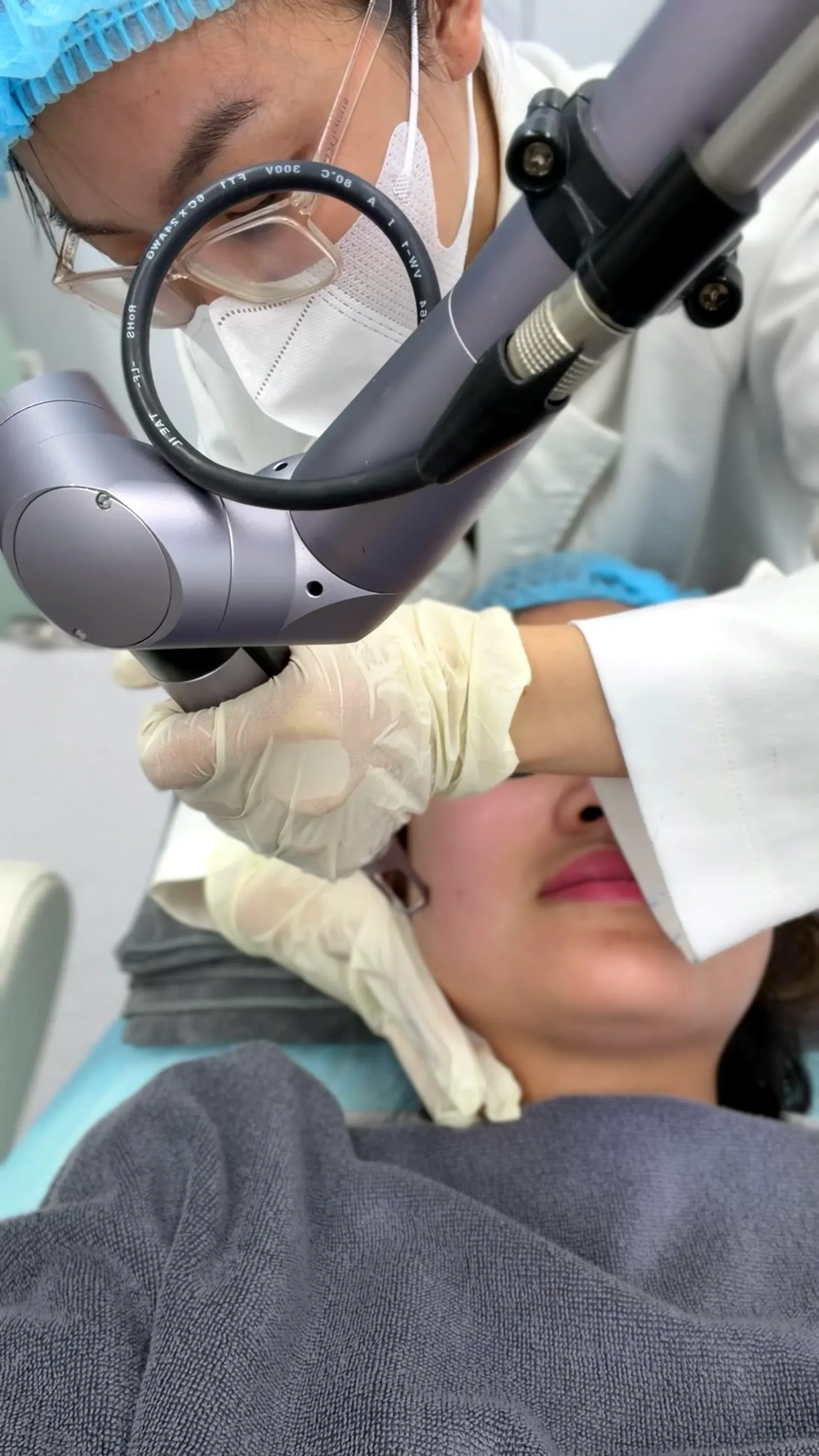
Fractional CO2 laser in Ho Chi Minh City should be done at a facility with a dermatology licence, where a doctor personally sets the parameters. BonBoz Clinic, 66–68 Võ Văn Tần, Xuân Hòa Ward (formerly District 3), Ho Chi Minh City, operates under licence 11113/HCM-GPHĐ issued by the Ho Chi Minh City Department of Health. The people who examine you and perform the laser are doctors, including Dr. Bùi Thị Kim Kha, Specialist Level I in Dermatology. The clinic publishes reference prices: VND 2–5 million per laser session, and multi-session scar combos at VND 3.9–25 million per course.
What does fractional CO2 laser do for pitted acne scars?
The CO2 beam is absorbed by water in the cells and vaporises tissue in thousands of microscopic columns a few hundred micrometres deep. The healthy skin between the columns helps the skin recover quickly, while the micro-injured zones stimulate contraction of old collagen and the production of new collagen over 4–12 weeks, gradually lifting the base of the scar. Only about 10–30% of the surface area is treated each time, so skin heals in about a week instead of the many weeks needed after fully ablative laser resurfacing.
Set expectations clearly from the start: laser improves scars partially and does not erase them. The American Academy of Dermatology (AAD) states that laser makes scars less noticeable but does not make them disappear, and that results may take several months to appear. DermNet also notes that very deep scars may improve but cannot be completely removed with laser.
Laser is best suited to mild to moderate boxcar scars, rolling scars (after the fibrous bands have been released), uneven skin texture and enlarged pores. Deep ice pick scars need TCA spot treatment in combination; rolling scars with fibrous bands pulling downward usually need subcision first. The mechanism and suitable candidates are described in detail on the fractional CO2 laser method page and in the article who is fractional CO2 laser suitable for.
Choosing a reputable place for fractional CO2 laser: what should you check?
The AAD stresses that the results of laser scar treatment depend heavily on the skill of the person performing it, and advises walking away if anyone promises to treat your scars before examining you. The table below helps you check any facility yourself.
| Criterion | How to check | BonBoz information |
|---|---|---|
| Dermatology specialty licence | Look up the licence number at tracuu.medinet.org.vn | 11113/HCM-GPHĐ (Dermatology), 10036/HCM-GPHĐ (Aesthetics), issued by the Ho Chi Minh City Department of Health |
| Who operates the device | Ask directly whether the person performing the laser is a doctor or a technician | A doctor performs the laser personally, not delegated to a technician |
| Scar classification beforehand | Ask whether they perform skin analysis and name your scar types (ice pick, boxcar, rolling) | The doctor performs skin analysis, classifies the scars, and checks for inflammatory acne and medication history |
| Personalised parameters | Ask whether energy and density are adjusted by area and skin tone | Parameters are set for each area and personalised for skin prone to hyperpigmentation |
| Clear pricing before treatment | Ask for a plan stating the number of sessions, techniques and total cost | The plan states the number of sessions, techniques and total cost after the examination |
| Follow-up between sessions | Ask whether they reassess you before the next session | A follow-up visit is scheduled before the next session; examinations and follow-ups within the plan carry no extra charge |
A more complete list is in the article 5 criteria for choosing where to treat pitted acne scars in Ho Chi Minh City.
Fractional CO2 laser prices at BonBoz
| Item | Reference price range |
|---|---|
| Fractional CO2 laser or subcision | VND 2–5 million/session |
| Multi-session scar combo (combined techniques) | VND 3.9–25 million/course |
| Microneedling | VND 1–3 million/session |
Reference prices published in November 2026; an exact quote is given after the examination, before you decide. Details are on the page cost of laser treatment for pitted acne scars.
Each session includes local anaesthesia, the laser procedure, and soothing care immediately afterwards; restorative topical medication for use at home is charged separately according to the prescription. The total cost varies with:
- The area and depth of the scars, which determine the number of sessions and the combo level.
- The energy level and number of sessions set by the doctor.
- Whether subcision or TCA spot treatment is combined.
- Skin with active inflammatory acne or darkening must be stabilised first, sometimes with additional preparatory treatment sessions.
A combo is a package of multiple sessions combining techniques, priced lower than the sum of individual sessions; you can still start with a single session. The clinic offers instalment payment through partner finance companies, subject to the partner's conditions.
A fractional CO2 laser session at BonBoz
- 1Examination and skin analysis: the doctor classifies the scars, checks for inflammatory acne, and asks about medication history, cold sores (herpes) and keloid scars.
- 2Face washing, then topical numbing for 30–45 minutes, after which the numbing cream is wiped off.
- 3Laser treatment: the doctor treats each area with the density, energy and depth that have been set; about 15–30 minutes for the whole face. You feel a hot, stinging sensation that is tolerable.
- 4Cooling, application of restorative medication and mineral sunscreen before you leave.
- 5Day-by-day aftercare instructions and a follow-up appointment before the next session.
Preparation before the session: according to BonBoz's instructions, stop topical retinoids at least 5–7 days beforehand and do not exfoliate for 1 week; the AAD advises stopping products containing retinoids or glycolic acid 2–4 weeks beforehand, so ask your doctor which stopping time suits your skin. Avoid sun exposure and do not tan for 2 weeks beforehand; arrive with clean skin and no makeup. The AAD notes that people with a tan or sunburn cannot have laser treatment because of the risk of burns or skin discolouration, and that people prone to cold sores should take preventive medication beforehand.
How long is recovery, and what restrictions apply?
- Days 1–2: skin is red, warm, with mild oozing; burning for a few hours after the session, like mild sunburn.
- Days 3–7: skin darkens and sheds tiny flakes. Do not pick at the flakes.
- Going back to work: many people return to work from day 3–4 with skin still pink if they use sun protection well; for jobs that depend on appearance, take 1 week off.
- Care: use the prescribed restorative medication, wash your face with physiological saline, use SPF 50 sunscreen and reapply every 2 hours when outdoors (per the AAD).
- Avoid for 1 week: steam rooms, heavy exercise, swimming pools.
- Strict sun protection for at least 4 weeks after each session is a requirement, not a recommendation.
Skin is smoother after 2–3 weeks; scars lift noticeably after 2–3 sessions because collagen needs 1–3 months to form. A course usually takes 3–5 sessions, 4–8 weeks apart, for moderate scars; severe scars need more. Doing sessions closer together is not faster and increases the risk of hyperpigmentation.
Vietnamese skin is prone to post-inflammatory hyperpigmentation (PIH), so temporary darkening is the main risk. If it appears, it usually fades after a few weeks to a few months; see also how post-acne marks differ from pitted acne scars.
Who should not have it, and when must it be postponed?
- Inflammatory acne, active cystic acne or infection in the treatment area — the acne must be stabilised first.
- A tendency to form keloids, or existing keloid scars on the face.
- Currently taking oral retinoid acne medication, or having stopped only recently, before the time your doctor requires has passed.
- Pregnancy or breastfeeding: there is not enough safety data, so it should wait.
- Recently sunburned skin, skin inflammation (dermatitis) or an active herpes flare-up.
- Being unable to maintain strict sun protection for 4 weeks after each session, for example because of continuous outdoor work.
Risks to know about: temporary hyperpigmentation, redness lasting several weeks on sensitive skin, infection or a herpes flare-up if aftercare is wrong, and patchy hypopigmentation or new scars if the parameters are too aggressive — which is why the parameters must be set by a doctor. For very dark skin or a history of long-lasting hyperpigmentation, the doctor may prefer RF microneedling instead of CO2.

If you live in Thủ Đức, Gò Vấp or another district, should you come to BonBoz in District 3?
What determines the result is the person who sets the parameters, correct scar classification and aftercare following the session — not the distance. A course of 3–5 sessions, each 4–8 weeks apart, means you do not need to travel often; what you should consider is whether you can keep your follow-up appointments and protect your skin from the sun while it is peeling. Whether you choose BonBoz or a place near home, compare it using the criteria table above.
Book an examination and laser treatment at BonBoz
- Address: BonBoz Clinic, 66–68 Võ Văn Tần, Xuân Hòa Ward (formerly District 3), Ho Chi Minh City.
- Opening hours: Monday – Sunday, 08:00–20:00.
- Phone: 0869 612 310.
- Licences: 11113/HCM-GPHĐ (Dermatology) and 10036/HCM-GPHĐ (Aesthetics), issued by the Ho Chi Minh City Department of Health, searchable at tracuu.medinet.org.vn.
- Doctor: Dr. Bùi Thị Kim Kha, Specialist Level I in Dermatology, practising certificate 009784/ĐL-CCHN (issued by the Đắk Lắk Department of Health), more than 8 years of practice, with a certificate in lasers and light-based therapy in dermatology.
- The initial examination and skin analysis are free. For other skin problems the clinic treats, see dermatology conditions treated at BonBoz.
References
- American Academy of Dermatology — 10 things to know before having laser treatment for a scar. <https://www.aad.org/public/cosmetic/scars-stretch-marks/laser-treatment-scar>
- DermNet — Laser resurfacing. <https://dermnetnz.org/topics/laser-resurfacing>
- American Academy of Dermatology — How to apply sunscreen. <https://www.aad.org/public/everyday-care/sun-protection/shade-clothing-sunscreen/how-to-apply-sunscreen>
Sources accessed on 11/11/2026.
Frequently Asked Questions
How much does fractional CO2 laser cost per session?
At BonBoz, a fractional CO2 laser session has a reference price of VND 2–5 million; multi-session scar combos cost VND 3.9–25 million per course. These are reference prices published in November 2026; an exact quote is given after the examination, before you decide. The specific amount depends on the area, the depth of the scars and the combined techniques.
How long does it take to heal after fractional CO2 laser?
Skin is red with mild oozing on days 1–2, then darkens and sheds tiny flakes until about day 7. Many people return to work from day 3–4 if they use sun protection well. After that, strict sun protection is still needed for at least 4 weeks to reduce the risk of hyperpigmentation.
Is CO2 laser effective?
Fractional CO2 laser improves mild to moderate boxcar and rolling scars over several sessions, because new collagen needs 1–3 months to form. The result is partial improvement, not complete removal of scars; the AAD also states that laser makes scars less noticeable but does not make them disappear. The doctor will discuss realistic expectations after skin analysis.
Besides CO2, are any other technologies used?
Yes, depending on the scar type: subcision for rolling scars with fibrous bands, TCA spot treatment for ice pick scars, PRP to support recovery, and microneedling for shallow scars. For very dark or pigmentation-prone skin, the doctor may prefer RF microneedling. The order of combination is arranged by the doctor according to the scar types on your face.
How does fractional CO2 laser differ from conventional CO2 laser and other lasers?
Traditional CO2 laser ablates the entire surface, with 2–4 weeks of recovery and higher risk; fractional laser treats only part of the area in microscopic columns, with recovery of about 1 week. DermNet describes non-ablative lasers as having faster recovery but being less effective than ablative lasers.
How many fractional CO2 laser sessions are needed?
Usually 3–5 sessions, 4–8 weeks apart, for moderate scars; severe scars need more. The doctor estimates this after skin analysis and adjusts it according to your response at each follow-up visit.
Does the doctor perform the fractional CO2 laser personally?
At BonBoz, a doctor performs the laser personally, not delegated to a technician. The clinic's dermatology doctors, including Dr. Bùi Thị Kim Kha (practising certificate 009784/ĐL-CCHN, with a certificate in lasers and light-based therapy in dermatology), examine you and give recommendations. At any facility, you should ask for the name and practising certificate number of the person operating the device.
Do I need maintenance after CO2 laser?
Scars that have improved do not need maintenance laser. What you need to do is control acne and use sun protection so that new scars do not form.
Content prepared by the BonBoz Clinic medical team.
This article is for reference only and does not replace an in-person examination or a doctor's diagnosis. Actual results vary by individual condition.