Where to get reputable facial PRP in Ho Chi Minh City? Effects, timeline, recovery and choosing a doctor
Where can you get reliable facial PRP injections in Ho Chi Minh City? This page covers what PRP is, what it can and cannot do for skin and pitted acne scars, how long it takes to work, how many days of recovery to expect, who should not have PRP, and six checks to make before choosing a clinic. BonBoz performs PRP for skin only and does not offer PRP for joints.

PRP facial injections should be done at a licensed medical facility, where a dermatologist examines you, draws your blood, separates the plasma in a sterile kit and performs the injection personally. In Ho Chi Minh City, BonBoz Clinic is located at 66–68 Võ Văn Tần, Xuân Hòa Ward (formerly District 3). The Ho Chi Minh City Department of Health has issued it licence 11113/HCM-GPHĐ for dermatology and 10036/HCM-GPHĐ for aesthetics. Dr. Bùi Thị Kim Kha, Specialist Level I physician, practising certificate 009784/ĐL-CCHN, examines patients and performs PRP for facial skin and scars.
In short: PRP smooths the skin to a moderate degree, and clear improvement is usually seen after about 2–3 weeks. Redness and mild swelling at the injection points usually resolve within 1–2 days, and you can wear makeup again after 24 hours. PRP does not fill hollow cheeks or lift sagging skin, and for pitted acne scars it is only a supporting step alongside microneedling or laser. BonBoz performs PRP only for skin and scars and does not inject PRP into joints.
This article answers, in turn, the questions people ask most before booking: what PRP injection is, what facial PRP can and cannot do, how long it takes to work, how long recovery takes, who should not have it, and how to choose where to be injected and which doctor to see. Every study mentioned has its journal name and link in the sources section.
What is PRP injection?
PRP (platelet-rich plasma) is plasma rich in platelets, separated from your own blood. Following the procedure described on the PRP — platelet-rich plasma page, the doctor draws a small amount of venous blood, similar to a blood test, places it in a dedicated tube and spins it in a centrifuge. The exact amount of blood is decided by the doctor according to the kit and the area being treated. The plasma concentrated with platelets is separated out and injected as micro-points into the dermis, or applied to the skin through the tiny channels just created by microneedling or laser.
Platelets contain growth factors that take part in wound healing and tissue regeneration. When this concentrate is placed in the skin, PRP is expected to help the skin recover and to support collagen production. The word "expected" is deliberate here: response differs from person to person and depends on the quality of the platelets, how they are separated and how they are delivered to the skin.
When researching in other languages, you will come across the names PRP facial (English), плазмолифтинг (Russian) and 富血小板血浆 (Chinese; many people also say 自体血清, literally "autologous serum") for this same group of techniques. Because separation and injection methods can differ from one place to another, ask specifically about the procedure rather than relying on the name.
One variant you may hear about is PRF: the plasma is separated without anticoagulant, forming a fibrin scaffold that releases growth factors more slowly. Both PRP and PRF are supporting steps; the doctor chooses according to your goal and the area being treated.
What can facial PRP do, and what can't it do?
This is the part most worth reading carefully, because most disappointment after PRP comes from wrong expectations.
What studies have found. A systematic review by authors from Northwestern University (USA), published in 2020 in Archives of Dermatological Research, pooled 24 studies with 480 people who received PRP injections for signs of skin aging. The conclusion: PRP injection alone gives a modest improvement, at least temporarily, in appearance, skin texture and wrinkles, and the most convincing evidence is for skin texture. The improvement was usually under 50% as assessed by doctors, although the people treated were generally satisfied. The authors also stated clearly that it is not known how long the effect lasts, and that the way PRP is prepared varied widely between studies.
Another systematic review, published in 2023 in Plastic and Reconstructive Surgery, found that 11 of 12 studies reported improvement, but many of the measures were subjective. The authors recommended more randomised controlled trials to confirm effectiveness.
So, for facial skin, PRP suits these goals:
- Rough skin, uneven texture, visible pores and an uneven skin surface.
- Dull skin where you want a mild improvement in hydration and elasticity.
- Supporting skin recovery after laser or microneedling within a regimen set by your doctor.
- People who want to use their own material, or whose skin has previously been sensitive to foreign products.
PRP cannot:
- Fill hollow cheeks or deep grooves, or reshape the face. To restore volume you need hyaluronic acid (HA) filler.
- Lift clearly sagging skin. This calls for other methods; the doctor will tell you plainly if PRP does not meet your goal.
- Fill pitted acne scars on its own. See the section right below.
- Replace treatment of skin diseases such as active inflammatory acne or melasma; these conditions need their own diagnosis and treatment plan.
If your main goal is plump, hydrated, brighter skin, the doctor may compare PRP with micro-point mesotherapy or hydrating skin booster to choose the right option, rather than defaulting to PRP.
PRP and pitted acne scars: a supporting role, not the main method
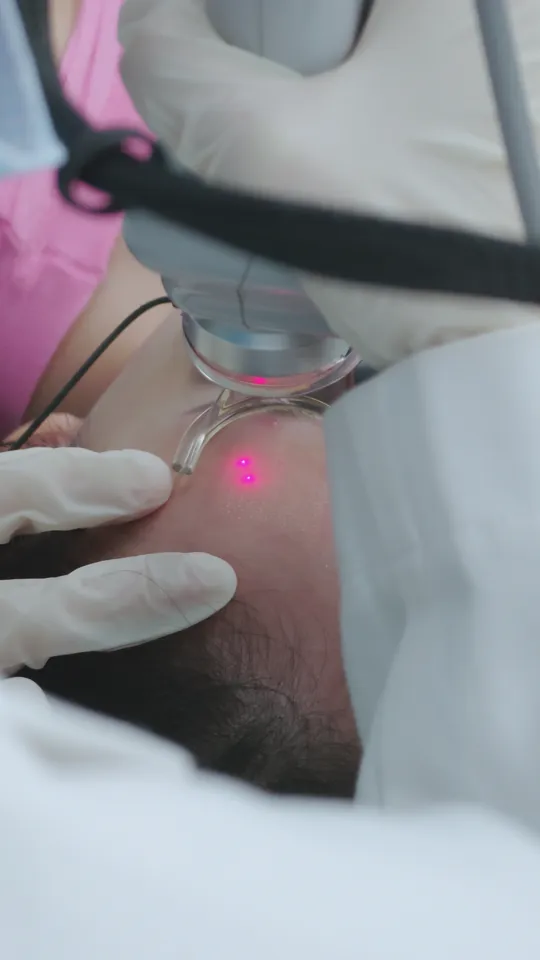
For pitted acne scars, what really stimulates the skin to regenerate is controlled injury: micro-point microneedling, fractional CO2 laser or subcision. PRP is applied right after these steps to support the recovery phase.
A meta-analysis published in 2022 in Dermatologic Therapy pooled 11 randomised controlled trials with 313 people with moderate to severe pitted acne scars. The fractional CO2 laser plus PRP group showed greater clinical improvement and higher satisfaction than the laser-only group. The point to read correctly is that the comparison is laser plus PRP versus laser alone, not PRP instead of laser. There is no reason to expect scars to fill in when PRP is used alone for pitted acne scars.
The article What is PRP for pitted acne scars, and when to combine it explains this supporting mechanism in more detail, and 6 methods to treat pitted acne scars helps you see which main method suits your scar type.
How long does PRP take to work, and how many sessions are needed?
According to BonBoz's post-PRP care guidance, the usual milestones are:
- First week: skin recovers faster, especially when PRP is combined with microneedling or laser.
- After about 2–3 weeks: clearer improvement in smoothness and freshness of the skin.
- Over later sessions: new collagen forms gradually, so changes in texture and elasticity build up over time and are not complete after a single session.
As for the number of sessions, there is no general figure: the doctor decides after the examination, based on your goal and how your skin responds. For facial skin, the plan usually consists of a few sessions several weeks apart, followed by maintenance. When PRP is a supporting step in a pitted acne scar regimen, the number of sessions follows the main procedure.
One thing to know before buying a long course: as the 2020 review noted, science cannot yet say how long the effect of PRP on skin lasts. A trustworthy facility will therefore schedule a reassessment after each stage, rather than promising a figure such as "lasts X years".
How long does recovery take after PRP?
With micro-point PRP injection on the face, downtime is short. When PRP is combined with microneedling or laser, recovery time is mainly determined by the accompanying procedure.
| Time | How the skin usually looks | What you should do |
|---|---|---|
| Right after the session | Red dots at the injection points, mild swelling, possibly small bruises | No makeup for the first 24 hours, do not rub your face |
| Days 1–2 | Redness, mild swelling and small bruises (if any) gradually fade | Protect from the sun carefully, wash your face gently; makeup is possible again once the first 24 hours have passed |
| First 3 days | Most people are back to normal activities | Avoid certain foods as the clinic advises: sticky rice, bananas, sweet potato, seafood, beef, chicken, bamboo shoots, fermented fish sauce |
| First 7 days | Skin is still recovering | Avoid heat: no steam rooms or saunas |
| If PRP is combined with microneedling or laser | Redness and peeling according to the accompanying procedure | Follow the care instructions for that procedure |
When to contact the facility again: swelling, heat and redness that increase after a few days, discharge, increasing pain, or fever. These may be signs of infection, a risk linked to a non-sterile process of blood draw, separation and injection, not to your own plasma itself.
Preparing before the session, according to the guidance on BonBoz's PRP method page: eat lightly before the blood draw, drink enough water, and avoid alcohol and non-steroidal anti-inflammatory drugs for 2–3 days beforehand as your doctor advises, because they affect platelet function. Do not stop medication for an illness on your own; bring a list of your medications for the doctor to review.
Who should not have PRP?
Because PRP comes from your own blood, the risk of an allergy to the substance itself is very low. But "autologous" does not mean everyone can have it. Tell your doctor, and injection usually has to be postponed or not done, if you:
- Have a clotting disorder, low platelet count or a blood disease.
- Are taking anticoagulant medication and have not discussed it with the doctor.
- Have a systemic infection, or an infection of the skin in the area to be injected.
- Are being treated for a malignant condition.
- Are pregnant or breastfeeding, because there is not enough safety data.
- Expect PRP alone to fill pitted acne scars or hollow cheeks.
The doctor will ask about your history of clotting problems, blood disease and current medications, and may request tests before injection if needed.

Where to get PRP with confidence: six self-checks before booking
These six points apply to every address, and BonBoz is no exception. With PRP, the main risk lies not in the "drug" but in the process, so questions about sterility and who performs the procedure matter more than any advertising.
- 1The facility's licence: ask for the licence number and look it up yourself on the Ho Chi Minh City Department of Health website. The facility's name, permitted specialty and address must match the place where you will be injected. Because PRP involves both a venous blood draw and injection into the skin, have it done at a licensed medical facility rather than a beauty salon.
- 2Who draws the blood, who injects: know in advance the name and practising certificate number of the doctor who will hold the needle, not the person who appears in the advertising.
- 3Single-use kit: ask to see the blood tube and centrifuge kit still sealed and opened in front of you, with the label clearly showing manufacturer, batch and expiry date.
- 4Whose blood, used for that person: the blood tube must be labelled with your name and processed right during the session, never mixed with anyone else's.
- 5Examination before the blood draw: the doctor asks about clotting history, current medications, underlying conditions and recent skin procedures, and only then tells you whether PRP suits you.
- 6Clear about what PRP cannot do, and a quote given after examination: the consultant should say clearly when your goal needs a different method, and the quote should state the number of sessions and how treatments are combined.
As for "where is best", there is no single answer: the right place is one that can answer all six points above and where you can easily return for follow-up.

How to choose a PRP doctor
"Which doctor is good" is hard to answer by gut feeling, but a few concrete criteria help: a practising certificate in the right specialty of dermatology, work at a facility with an operating licence, personally examining and injecting you, and being able to explain why they chose PRP, and whether micro-point injection or a combination with microneedling or laser, for your skin condition.
A good sign is a doctor who is willing to say "PRP is not the main option for this case". For deep pitted acne scars, hollow cheeks or sagging skin, that honest answer saves you both money and time.
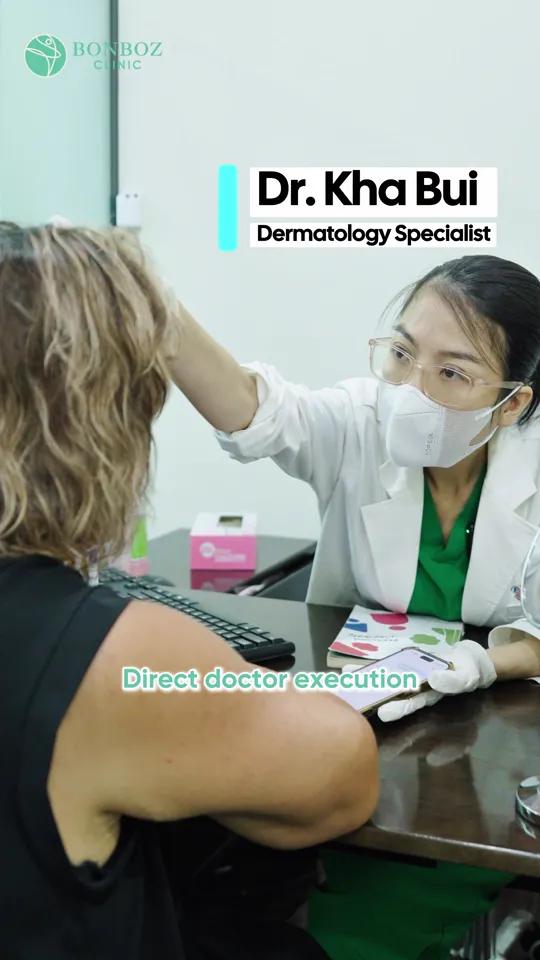
At BonBoz, the person who examines you and performs PRP is Dr. Bùi Thị Kim Kha, Specialist Level I physician, who specialises in dermatology, practising certificate 009784/ĐL-CCHN. The doctor decides whether to use PRP based on your goal and constitution, then performs it personally.
BonBoz does not offer PRP joint injections
PRP is also used in musculoskeletal medicine, for example injected into the knee joint, tendons or ligaments. That is the field of orthopaedic and musculoskeletal specialists, with completely different indications and techniques.
BonBoz Clinic performs PRP only for skin and scars and does not inject PRP into joints, tendons or muscles. If you are looking for PRP for joint pain, go to a facility with an appropriate musculoskeletal specialty.
Facial PRP at BonBoz Clinic
A PRP session at BonBoz goes through three stages:
- Before the injection: the doctor examines you, asks about your history of allergies, medical conditions and current medications, and determines whether PRP is suitable and how to use it: micro-point injection of the face, or applied to the skin after microneedling or laser in a pitted acne scar regimen.
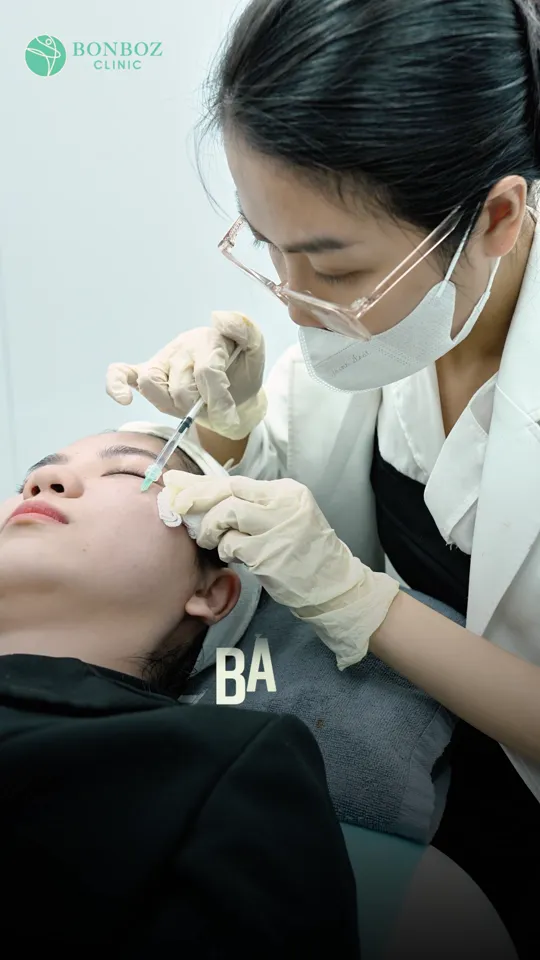
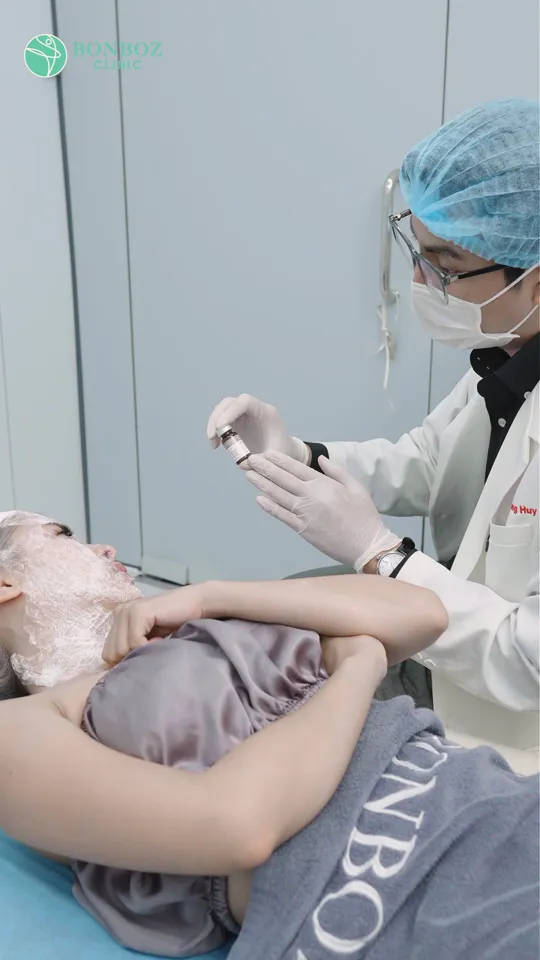
- During the injection: blood is drawn and the plasma separated using a sterile single-use kit; topical numbing cream is applied; the doctor performs the procedure personally.
- After the injection: a follow-up visit is scheduled to assess the result, along with instructions on what to avoid in the early period.
Prices are not listed in this article, because the total cost changes with the number of sessions and which procedure PRP is combined with. The PRP cost page explains the factors that change the price. BonBoz has a price list displayed at the clinic, and the doctor advises on the price for each case after examination, with no extra charges once a quote has been given.
Information for cross-checking: BonBoz Clinic, 66–68 Võ Văn Tần, Xuân Hòa Ward (formerly District 3), Ho Chi Minh City · licences 11113/HCM-GPHĐ (Dermatology), 10036/HCM-GPHĐ (Aesthetics) issued by the Ho Chi Minh City Department of Health · doctor in charge of PRP: Dr. Bùi Thị Kim Kha, Specialist Level I physician, practising certificate 009784/ĐL-CCHN.
Frequently asked questions
Where can I get reputable facial PRP in Ho Chi Minh City?
Choose a place licensed by the Department of Health for the right specialty, with a doctor holding a practising certificate who personally examines and injects you, and a single-use blood draw and centrifuge kit opened in front of you. BonBoz Clinic's two licence numbers (11113/HCM-GPHĐ and 10036/HCM-GPHĐ, address 66–68 Võ Văn Tần) can be checked yourself on the Ho Chi Minh City Department of Health lookup page. Wherever you choose, it should pass all six self-checks in this article.
What is PRP injection?
It is the injection into the skin of platelet-rich plasma, separated from a small amount of your own blood, to support skin recovery and improve texture.
How long does PRP take to work?
According to BonBoz's guidance, results usually improve clearly after about 2–3 weeks and build up further over later sessions. The improvement is usually moderate and differs from person to person.
How long does recovery take after PRP?
With micro-point facial injection, red dots and mild swelling usually resolve within 1–2 days. You can wear makeup again after 24 hours, avoid steam rooms for 7 days, and avoid certain foods for the first 3 days as the clinic advises. If PRP is combined with microneedling or laser, recovery time follows the accompanying procedure.
Does PRP fill pitted acne scars or hollow cheeks?
No. For pitted acne scars, PRP supports recovery after microneedling, laser or subcision; those techniques are the main methods. Hollow cheeks need a filler, not PRP.
Is PRP safe?
PRP is autologous, so the risk of allergy is very low. The risks lie in sterility and technique, such as bruising, mild swelling, or infection if the process is not sterile. People with a blood disease, taking anticoagulants, pregnant or breastfeeding need to tell the doctor beforehand.
Does BonBoz offer PRP for the knee joint?
No. BonBoz performs PRP only for skin and scars. PRP for joints, tendons and muscles belongs to the musculoskeletal specialty, so you should look for a facility with that specialty.
How much does PRP cost?
Cost is calculated per session and depends on how it is combined (injection alone or with microneedling or laser) and the number of sessions. The PRP cost page explains how it is calculated; the doctor advises a specific price after examination.
References
- Maisel-Campbell AL, Ismail A, Reynolds KA, et al. A systematic review of the safety and effectiveness of platelet-rich plasma (PRP) for skin aging. Archives of Dermatological Research, 2020;312(5):301–315: PubMed.
- Gentile P, Garcovich S. Systematic Review: Platelet-Rich Plasma Use in Facial Rejuvenation. Plastic and Reconstructive Surgery, 2023;152(1):72e–82e: PubMed.
- Aljefri YE, Ghaddaf AA, Alahmadi RA, et al. Ablative fractional carbon dioxide laser combined with autologous platelet-rich plasma in the treatment of atrophic acne scars: A systematic review and meta-analysis. Dermatologic Therapy, 2022;35(12):e15888: PubMed.
*Article updated on 11/11/2026. The information in this article helps you prepare your questions; the decision to have PRP injections requires an in-person examination by a doctor.*
This article is for reference only and does not replace an in-person examination or a doctor's diagnosis. Actual results vary by individual condition.