
Rhinoplasty in Vietnam: cost in Ho Chi Minh City for three techniques

Get a free review of your concern

Leave your phone or WhatsApp number. We can share a price range and book the right doctor. We reply in writing during opening hours, 8:00–20:00 Vietnam time. Night messages are answered after we open at 8:00.

Include your country code, for example +1, +44 or +61. A Vietnamese number also works.

Free consultation, no obligation. The doctor decides the treatment plan only after examining you in person.

This site is protected by reCAPTCHA and the Google Privacy Policy and Terms of Service apply.

Message us on WhatsApp

Licensed clinic: 11113/HCM-GPHĐ (Dermatology) and 10036/HCM-GPHĐ (Aesthetics). Treatments are performed by doctors with practising certificates. See our licences

The cost of rhinoplasty in Vietnam at BonBoz Clinic depends on the technique: a bridge implant with cartilage tip cover costs VND 15–30 million (≈ USD 590–1,170), semi-structural rhinoplasty VND 25–45 million (≈ USD 980–1,760), and full structural rhinoplasty with your own cartilage VND 45–75 million (≈ USD 1,760–2,930). The clinic operates in Ho Chi Minh City under Department of Health licences No. 10036/HCM-GPHĐ and No. 11113/HCM-GPHĐ, and Dr Nguyen Xuan Vu operates in person. Stitches come out 10–14 days after surgery, so together with the consultation day plan about 15–16 days in the city. The surgeon confirms the final price after examining you, and it does not change after that.

No WhatsApp? Leave your number in the form and choose how you would like us to contact you.

Rhinoplasty cost in Vietnam: price table

These are indicative ranges from the clinic’s price list. Within a range, the price depends on the bridge material (a Korean implant costs less than Surgiform), where the cartilage is taken from and how complex the case is. Revision rhinoplasty usually costs more than a first operation, because the surgeon has to remove old material and work with scar tissue.

TreatmentVietnamese dong (VND)US dollars (USD)
Bridge implant + cartilage tip cover (S-line / L-line implant, ear cartilage or Megaderm)VND 15–30 million≈ USD 590–1,170
Semi-structural rhinoplastyVND 25–45 million≈ USD 980–1,760
Full structural rhinoplasty (Korean implant / Surgiform / rib cartilage)VND 45–75 million≈ USD 1,760–2,930

Prices are indicative. Payment at the clinic is in Vietnamese dong; US dollars are converted for convenience at the Vietcombank rate of 17/11/2026 and rounded. The doctor confirms the final price after the examination, and it does not change after that.

What the price includes

  • surgeon consultation and examination, pre-operative tests;
  • anaesthesia (usually general anaesthesia for the structural technique);
  • harvesting of your own cartilage and the bridge material;
  • consumables and medication, follow-up visits, splint change and stitch removal.

How the three techniques differ

  • Bridge implant with cartilage tip cover — suits a nose with a strong base that needs a higher bridge and a neater tip. The bridge is raised with an implant and the tip is covered with ear cartilage or Megaderm; the operation is done under local anaesthesia.
  • Semi-structural rhinoplasty — the tip is reinforced with your own cartilage so it can hold a more visible change of shape. It takes 60–120 minutes.
  • Full structural rhinoplasty — the surgeon rebuilds the columella, septum and tip from your own cartilage (septal, ear or rib; rib cartilage is often used with this technique). It is the most complex option: 2–3 hours, usually under general anaesthesia, and it allows the largest change of shape.

The surgeon chooses the technique after seeing your nose in person: if the bridge only needs a small lift, a structural operation may be more than you need, and he will suggest a simpler and cheaper option.

Your trip, day by day

  1. Before you fly: send photos of your nose (front, profile and from below), what you would like to change and your travel dates on WhatsApp. Our English-speaking staff collect your photos, and the surgeon’s assessment gives you a matching price range.
  2. Day 1: in-person examination by Dr Vu, tests, choice of technique, and the final plan and price.
  3. Surgery day: the operation and monitoring at the clinic. Cold compresses for the first 48 hours; sleep on your back with your head raised.
  4. The following days: drains (if used) come out on day 1, check-up on day 2, splint change on day 5, check-up on day 7.
  5. Days 10–14 after surgery: stitch removal. After that you can fly home.
  6. At home: after structural rhinoplasty, marked swelling and bruising last 2–3 weeks, tip swelling settles over 3–6 months and the final shape is reached at about 12 months; no glasses resting on the nose for 8 weeks. After semi-structural rhinoplasty or a bridge implant with tip cover, recovery is shorter: no glasses for 4–6 weeks, final shape after 6–12 months.

How to check a clinic before you travel

In Vietnam a private clinic may only perform surgery under a licence from the health authorities; in Ho Chi Minh City licences are issued by the Department of Health. BonBoz Clinic holds two licences from the Ho Chi Minh City Department of Health: No. 10036/HCM-GPHĐ (aesthetic medicine, including plastic surgery) and No. 11113/HCM-GPHĐ (dermatology). The numbers and scans are published on our licence page, and you can check them on the Department’s portal.

The doctor who treats you must also hold a personal practising certificate. Ask any clinic for its licence number and the name of the doctor before you pay a deposit: if you get no clear answer, keep looking.

BonBoz Clinic licences · Department of Health facility lookup (in Vietnamese)

How many days to stay in Ho Chi Minh City after rhinoplasty

Full structural rhinoplasty
about 15–16 days: one day for the consultation, splint for 7–10 days, stitches out 10–14 days after surgery
Semi-structural rhinoplasty
stitches also come out 10–14 days after surgery — plan about 15–16 days
Bridge implant with tip cover
stitches also come out 10–14 days after surgery — plan about 15–16 days
Revision rhinoplasty
the surgeon gives the length of stay and price after examining you

Do not book your return flight until the surgeon has confirmed the technique and the check-up schedule.

Who treats you

The same doctor examines you, treats you and sees you at follow-up visits: Dr Nguyen Xuan Vu — Master of Medicine, Specialist Level II in plastic surgery (practising certificate No. 007827/ĐL-CCHN), with more than 15 years of experience in plastic surgery.

Dr Nguyen Xuan Vu’s profile →

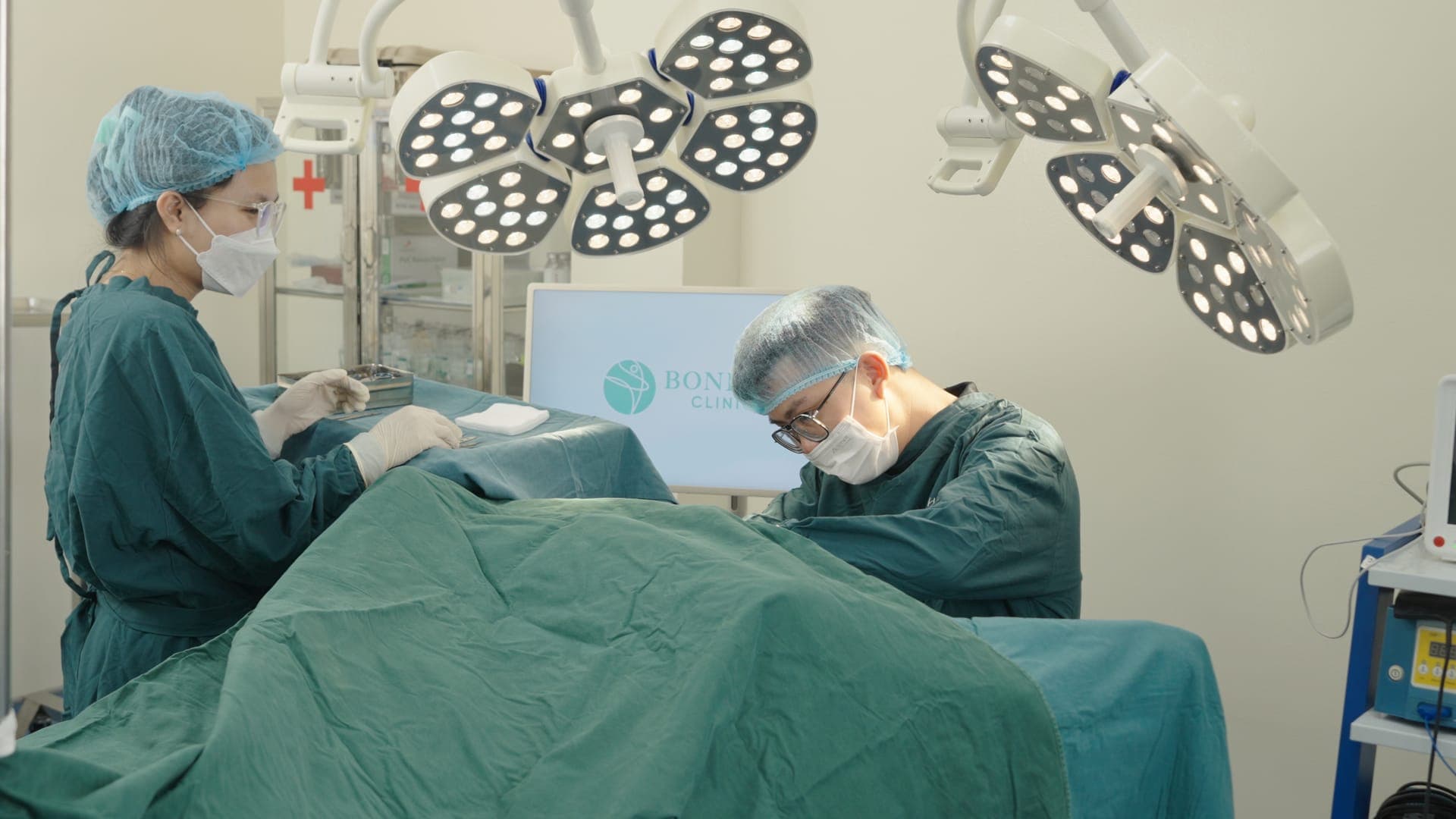
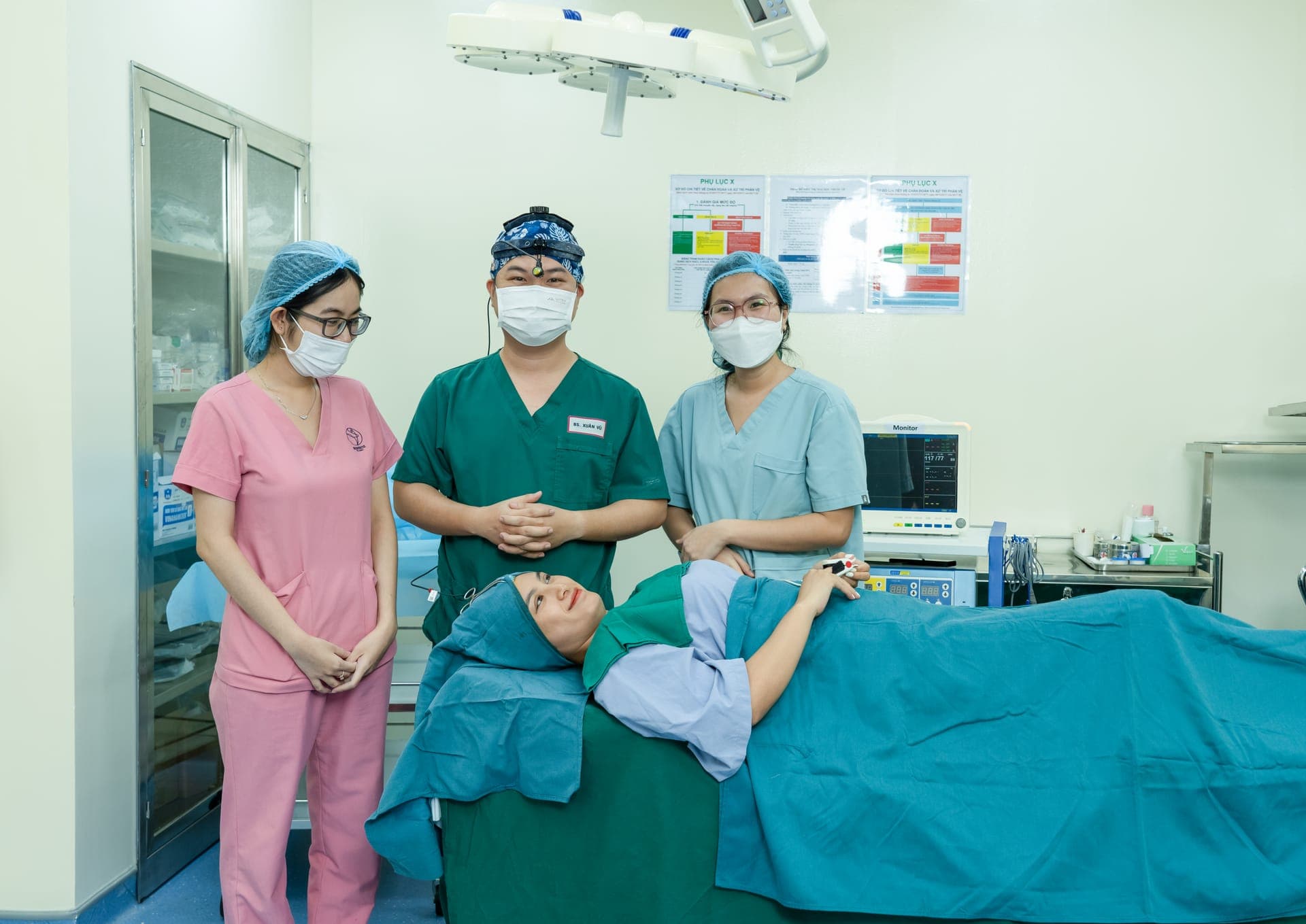
Operating room at BonBoz Clinic in Ho Chi Minh City during surgerySurgical team at BonBoz Clinic

Before you decide: what the doctor wants you to know

Quoted from the clinic’s published medical articles. Your own risks and suitability are explained by the doctor at the consultation.

Comprehensive structural rhinoplasty

Comprehensive structural rhinoplasty is an open technique that rebuilds the entire nasal framework. It involves lengthening the septal cartilage, constructing the columella / nasal strut, and shaping the nasal tip with autologous cartilage (septal, ear, rib). It can also be combined with materials placed on the nasal dorsum (bridge of the nose). It is suitable for short upturned noses, bulbous tips, thick skin, deviated noses and revision rhinoplasty. The rhinoplasty surgery takes 2–3 hours, swelling lasts 2–3 weeks, and the final shape is seen at 12 months.

Possible risks

  • Swelling and bruising for 2–3 weeks; numbness of the nasal tip for a few months
  • Infection or hematoma (rare, treated early)
  • Rib cartilage graft warping over time if not handled correctly
  • Deviation or asymmetry that may need a minor adjustment after 12 months (low incidence)

Needs careful assessment or not advised when

  • Simple low nasal dorsum (bridge of the nose) with a tip that needs no major changes (cartilage-wrapped or semi-structural rhinoplasty is enough; structural rhinoplasty would be excessive)
  • Uncontrolled underlying medical conditions; coagulation disorders; not eligible for general anaesthesia
  • Pregnant or breastfeeding
Read the full article →

Source: BonBoz Clinic medical article

Semi-Structural Rhinoplasty

Semi-structural rhinoplasty combines an artificial implant to elevate the nasal bridge with columellar strut support and tip reshaping using autologous cartilage (septal or ear cartilage), while preserving most of the underlying cartilaginous framework. It is ideal for low noses with a moderately bulbous or slightly short tip that requires improved projection. The level of invasiveness and recovery time fall between standard cartilage-wrapped (tip-cover) rhinoplasty and full structural rhinoplasty.

Possible risks

  • Swelling and bruising for 2 weeks; numbness at the nasal tip lasting a few weeks to several months
  • Infection, hematoma (rare, manageable with early intervention)
  • Dorsal or columellar deviation; temporary nasal tip stiffness
  • Implant visibility or redness in patients with thin skin (lower risk compared to cartilage grafting alone, thanks to columellar strutting and tip cushioning)

Needs careful assessment or not advised when

  • Severely damaged, contracted, or multiple-revision nose (requiring total structural rhinoplasty with rib cartilage)
  • Significantly bulbous and severely short, upturned nasal tip (semi-structural rhinoplasty is insufficient)
  • Insufficient septal/ear cartilage and unwilling to harvest rib cartilage
Read the full article →

Source: BonBoz Clinic medical article

How to book from abroad

  1. Send us your photos and travel dates

    Message us on WhatsApp or Messenger with a few photos of the area you want treated and the dates you will be in Ho Chi Minh City.

  2. Remote consultation with Annie

    Annie, our international patient coordinator, arranges your remote consultation by message or video call with our English-speaking staff, who will give you a price range and tell you how many days you should stay.

  3. Deposit to hold your appointment

    If you want to go ahead, Annie sends a bank transfer QR code in the chat for the agreed deposit. The deposit terms are explained in the chat before you pay.

  4. Appointment that fits your flights

    We book your visit around your flight dates. The doctor examines you in person and confirms the treatment plan and final price before anything is done.

Frequently asked questions

How much does rhinoplasty cost in Vietnam?

At BonBoz Clinic in Ho Chi Minh City: bridge implant with cartilage tip cover VND 15–30 million (≈ USD 590–1,170), semi-structural rhinoplasty VND 25–45 million (≈ USD 980–1,760), full structural rhinoplasty VND 45–75 million (≈ USD 1,760–2,930). The surgeon confirms the final price after examining you.

What is included in the rhinoplasty price?

The surgeon’s consultation, tests, anaesthesia, harvesting of your own cartilage, the bridge material, consumables and medication, follow-up visits, splint change and stitch removal. Once the surgeon has fixed the price, there are no extra charges.

Why does structural rhinoplasty cost more?

It takes longer (2–3 hours), is usually done under general anaesthesia, often uses rib cartilage or cartilage from several sites, and needs a longer follow-up. The price reflects the size of the operation, not only the materials.

How long do I need to stay in Vietnam after rhinoplasty?

With all three techniques, stitches come out 10–14 days after surgery, so plan 15–16 days including the consultation day. For revision rhinoplasty the surgeon confirms the length of stay at the remote consultation, before you buy tickets.

Do you perform revision rhinoplasty?

Yes. A revision is usually more complex and more expensive than a first operation, and sometimes you need to wait several months for the tissues to settle. Send photos and describe what was done before — the surgeon will tell you what is possible.

Can I communicate in English?

Yes. Our staff reply in English on WhatsApp, and you can also leave your number in the form on this page.

WhatsAppCallBook